


Collaborating together
Sustainability is a sector-wide challenge that requires sector collaboration

Register your initiative
The Coffee Sustainability Initiatives Map is a publically accessible interactive tool and database to provide greater transparency on sustainability and support initiatives and investments in coffee producing countries.The Story Behind the Coffee Sustainability Initiatives Map:
to provide greater transparency on sustainability and support initiatives and investments in coffee
Methodology
The information on initiatives in this map is based on publicly available information. It builds upon the work of similar mapping exercises, from associations, public sector databases, and collaborative initiatives. The first stage of this mapping was led by the ICO Coffee Public-Private Task Force (CPPTF) Technical Workstream 3 Policies of Importing Countries (TWS3 IC), which created a “MappingDatabase of Support to the Coffee Sector” based on secondary data sources.
ICO engaged with ITC via its Alliances for Action programme to complement the database, leveraging the reach and expertise of the Coffee Guide Network to include additional projects and to make the data more accessible and user-friendly. Together with ICO, TWS3 IC, and ITC, the team validated, updated, and cleaned the data, categorizing the projects in the database along Sustainable Development Goals and sustainability thematic areas of focus.
Justification of the mapping project:
The future of the global coffee sector faces long standing environmental, social, and economic sustainability challenges. The complexity, scale, and urgency of sustainability challenges requires global coordination of interventions and strategies; however, many actors are responding with individual efforts. The dispersed and sometimes private nature of information on initiatives prevents opportunities for global coordination and limits the potential impact. In order to achieve global impact quickly, value chain actors, development agencies and governments need to respond in consideration of what other actors are doing, and where.
The this tool aims to consolidate sustainability initiatives in coffee producing countries onto one platform. It can be used by you for:
- Opening opportunities for collaboration, co-investment, and knowledge sharing.
- Deepening and improving individual sustainability strategies toward a collective approach, and understand.
- Understanding overlaps, gaps, and opportunities to allow for better focus of future funding decisions
About the dataset
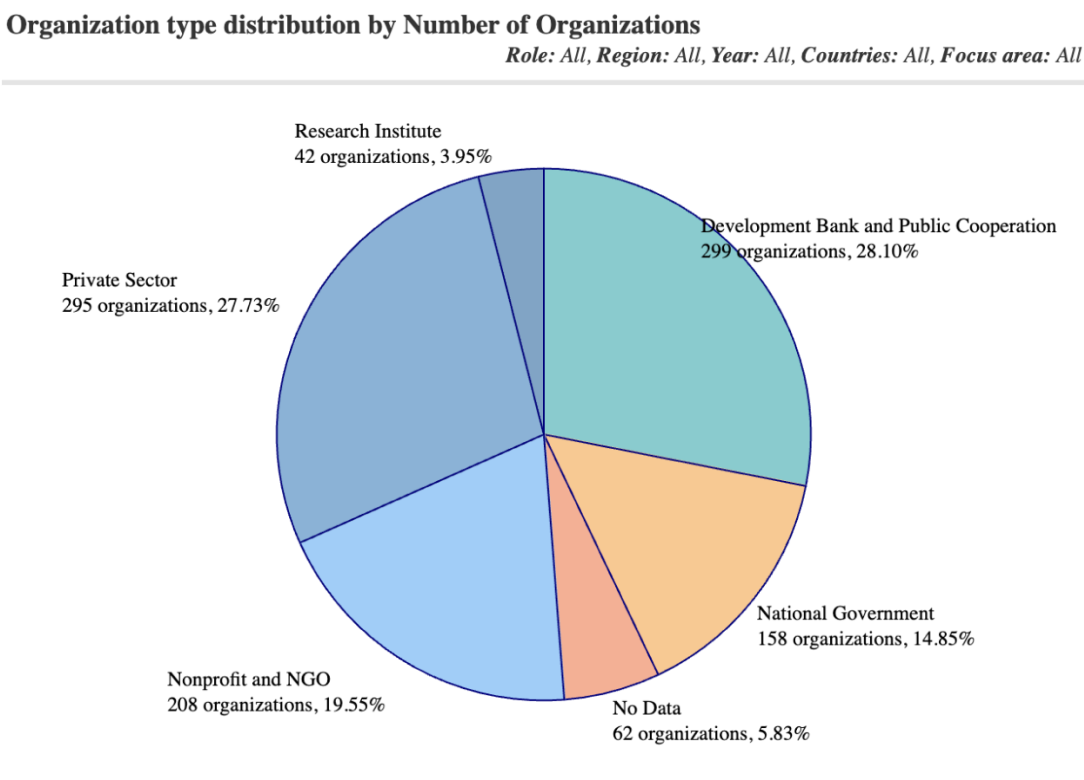
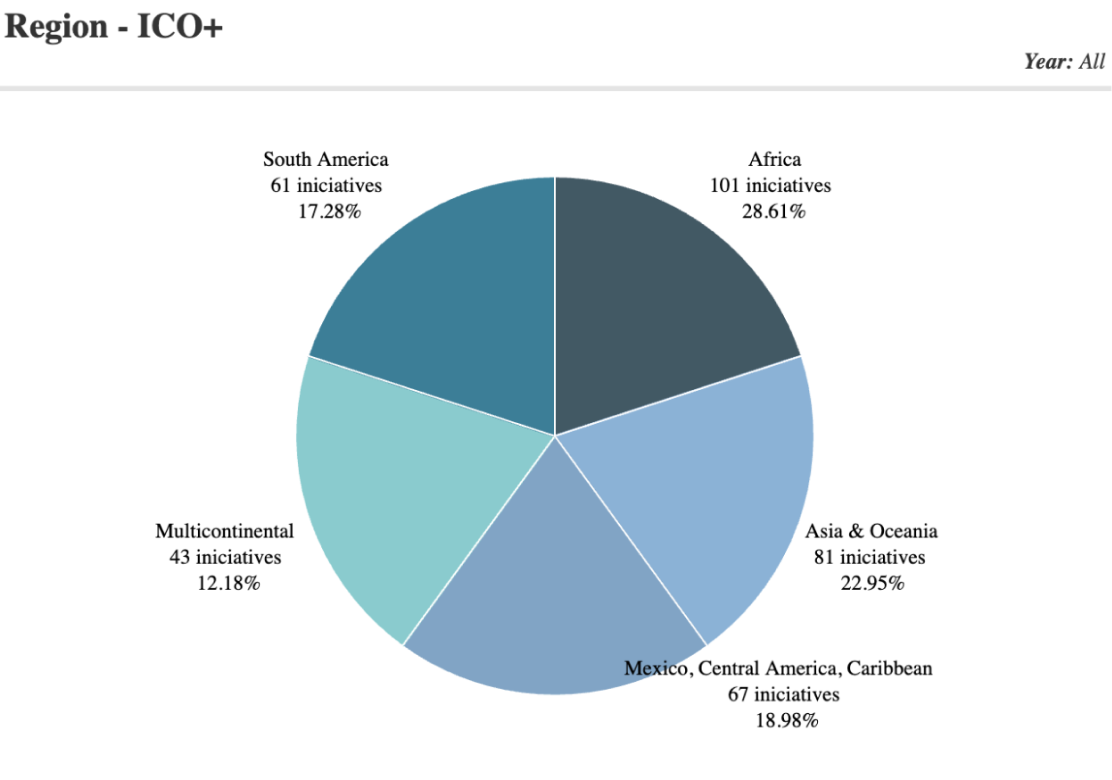
367 projects, both public and private initiatives supporting the sustainability in 53 coffee producing countries, have been included, for projects that are implemented during the 10-year time horizon from 2017 to 2027. Organizations listed include both funders and implementing partners from government, multilaterals, development organizations, private sector, social impact investors, and NGOs.
The map will be updated yearly in collaboration with the mentioned stakeholders and existing collective reporting initiatives.
Although the information contained herein has been carefully and thoughtfully analysed, improvement, revision and cleaning of data is a continuous process. In case you notice any inaccuracies, please get in touch with us so that we can update the data to make this database even more helpful for the coffee sector.
The following charts show the distribution of types of organizations, including both funders and implementing partners, as well as the regions of initiatives in the dataset.
Who is behind this mapping tool?
A collaborative effort to foster collaboration and informed decision-making in sustainability
The " Coffee Sustainability Initiatives Mapping Tool” is a collective effort requested and co-created by members of the ICO Coffee Public-Private Task Force (CPPTF) Technical Workstream 3 Importing Countries (TWS3 IMP) and the International Trade Centre (ITC) through its Alliances for Action initiative the Coffee Guide Network, with co-funding from the European Commission DG INTPA F3 and ITC Trust Fund donors. This mapping reflects broad public and private sector interest in consolidating current sustainability initiatives in the coffee sector.
The Coffee Public-Private Task Force has the overall objective to build consensus between public and the private actors on priority issues and actions to be implemented in order to ensure a sustainable and fair global coffee sector at the local and global levels. To this end, collaborative public-private partnerships aim to achieve complementary specific objectives, including: coordinating interventions at the sector level and ensuring full integration of the gender and youth agenda. In line with these objectives, the ICO aims to provide greater transparency on sustainability initiatives in the coffee producing countries in a centralized platform, as a public good for the coffee sector.
The Coffee Guide Network, hosted by the International Trade Centre, is a group of individuals from across the global coffee sector advancing and deepening knowledge in the ITC Coffee Guide. Sustainability is among the new chapters of the 4th edition of The Coffee Guide, highlighting both the complexity of the issues as well as different approaches to meeting environmental, social, and economic sustainability in the sector. Network participants decided that a shared understanding who is doing what and where toward sustainability objectives is needed to address these complex challenges as a sector.